Showing posts with label Musical. Show all posts

Thursday, 24 December 2020

Scrooge - 1970, film


Title:
Scrooge
 
Format:
Colour musical feature film
 
Country:
UK (although made with American money)
 
Production company:
Westbury Films, for Cinema Centre Productions
 
Year:
1970
 
Length:
113 minutes
 
Setting:
Victorian – specifically, 1860


Background:
In 1968, Dickens’s work had seen enormous success on the big screen with the release of Oliver!, a literally all-singing, all-dancing colour spectacular, adapted from the equally-successful stage musical version of 1960 by Lionel Bart. The success of Oliver! must have made the idea of creating a musical film from another of Dickens’s best-known works almost irresistible, although in this case the film was made directly for the screen. In fact, in something of a reversal of the way in which these things usually work, Scrooge was adapted into a stage musical in the early 1990s, and has often been revived since.
 
While Scrooge didn’t go on to achieve quite the same impact as Oliver!, it was certainly successful, being nominated for four Academy Awards. This included a nomination in the Best Original Song category for the showstopping Thank You Very Much, which is probably the song from the film which made the biggest impact and is its best-known number. The film itself turns up on British television every Christmas, often on one of the major channels, and is probably one of the most widely-known and best-loved versions of the story in the UK.
 
As is not uncommon with adaptations of the Carol, although this was made in England with a British cast and crew, the film was backed with American finance and produced for an American company. This rather works in its favour, though, having the authentic feeling of something made in the Carol’s home country, but with the budget to provide the spectacle you’d expect from a full-scale Hollywood musical.
 
Cast and crew:
One of the reasons for the great success of the film and its standing the test of time is surely down to the fact that it contains some of the absolute cream of British acting talent available at the time.
 
The cast is led by Albert Finney as Scrooge – as he was only 33 here, he’s aged-up surprisingly well for most of the scenes, but is also able to play the younger Scrooge in the Christmas Past section more convincingly than is usually the case when the same actor does both. Finney had come to prominence as part of the ‘Angry Young Man’ new wave of young British actors of the 1960s, starring in the likes of The Entertainer, Saturday Night, Sunday Morning and Tom Jones. One of his co-stars in the latter was Dame Edith Evans, a three-time Academy Award nominee and a Victorian by birth herself, who here appears as a rather different, matronly interpretation of the Ghost of Christmas Past.


There are some hugely esteemed names in other ghostly parts as well, with none other than Sir Alec Guinness seeming to enjoy himself hugely with a rather sarcastic and mischievous Marley. The Ghost of Christmas Present is played with the customary gusto by Kenneth More, who’d been the foursquare hero of black-and-white war films such as Reach for the Sky and Sink the Bismarck, as well as the acclaimed Titanic drama A Night to Remember. A major UK star of the fifties and early sixties, More was just past the peak of his movie fame here, but had recently enjoyed something of a renaissance as one of the leads of the enormously popular BBC television adaptation of The Forsyte Saga.
 
Speaking of British television, many of the supporting parts are filled with faces which will be familiar to anyone with a passing knowledge of some of its most popular programmes of the late 20th century. David Collings is well-remembered for his supporting roles in a huge number of popular drama series, including the likes of Doctor Who and Blake’s 7, and his recurring part of Silver in Sapphire and Steel. Catweazle’s Geoffrey Bayldon appears as toyshop owner Pringle, while renowned comic actor Roy Kinnear is one of the two Charitable Gentlemen.

 
Anton Rodgers appears as Tom Jenkins, a character not featured in the book, a hot soup seller who owes Scrooge money. Rodgers would later achieve TV fame as the star of sitcoms Fresh Fields and May to December, but his role here in Scrooge stands out as it’s he who gets the memorable Thank You Very Much number.
 
In fact, you could name pretty much anyone who has a speaking part as being a memorable turn from some other British film or television programme – Mary Peach, for example, as the wife of Scrooge’s nephew, who these days is well-remembered by Doctor Who fans for her role as Astrid Ferrier in the serial The Enemy of the World. 
 
Behind the cameras, Leslie Bricusse was responsible for the music and lyrics and also for the film’s screenplay as a whole. By this point, Bricusse had a strong reputation for his success with musical feature films. He’d provided the songs for the 1969 musical version of Goodbye, Mr Chips, and as with Scrooge had taken on screenplay duties in addition to the songs for the 1967 version of Doctor Dolittle. Bricusse won an Oscar for his work on Dolittle, and had also co-written the James Bond themes Goldfinger and You Only Live Twice – so he certainly had the sort of pedigree needed for the job of turning one of English literature’s best-loved stories into a musical.
 
Director Ronald Neame was by this point nearly sixty, and had enjoyed a long and successful career in film, initially as a cinematographer and then a producer. In the latter role he had experience of success with Dickens adaptations, having produced David Lean’s versions of Great Expectations and Oliver Twist in 1946 and 1948 respectively. Neame had turned to directing in the 1950s, notably helming the war film The Man Who Never Was, and after Scrooge went on to direct the Hollywood disaster movie The Poseidon Adventure. Coming into Scrooge, his previous film had been The Prime of Miss Jean Brodie, which had won a Best Actress Oscar for Maggie Smith.
 
Underdone Potato:
One issue with making a musical version is that you have to compress some of the other elements to make way for the songs. While there is nothing major or important missing from this version of the story, some nice bits are slimmed down – for example, the visit of Scrooge’s nephew, Harry in this version, loses some of the best bits of dialogue from the book.


Right from the very off, however, Finney’s, snivelling, sneering, meticulously coin-counting performance as Scrooge dominates and delights. It could, perhaps, risk falling into a kind of cartoon caricature, but Finney is far too fine an actor for that. All the little bits of business around his coins and his keys and his safes simply add flourishes, rather than detracting or distracting from what’s at hand.
 
David Collings makes for a much more charming and less wet and insipid Bob Cratchit than is often the case, and the same can be said for Richard Beaumont’s performance as Tim, who while having a boyish innocence to him is again stopped from being too sickly both by the acting and the scripting. He gets an early appearance in the story here, joining his father and one of his sisters on the walk home, a song number through the Christmas shopping. The walk home’s a bit harsh on Mrs Cratchit though, as we see him buying a Christmas pudding rather than her own home-made one being a triumph as described in the book. When Bob first meets them they are busy peering into the window of a toy shop, in a scene which makes me wonder if it may have been inspired by Tim also doing so in the 1951 version.

If you think fourpence is a bit steep for it, then you ought
to have let your wife make one like she does in the book!
 
Scrooge also gets a song on the way home, a journey upon which he checks up on various of his debtors. Even against the Christmas Carol opening and Father Christmas taunting of him by the carol singers, his song is perhaps the best of the opening section. It seems an odd choice in an uplifting Christmas family musical to have a song called I Hate People, perhaps, but it feels appropriate particularly to a British audience as you can easily imagine the song being performed by the main villain in a traditional festive pantomime.
 
Scrooge encounters the charitable gentlemen on his walk home rather than in the office on this occasion, but his dialogue with them is substantially similar. We then get one of the big name actors in supporting parts, as no less than Alec Guinness turns up clearly enjoying himself immensely as quite a darkly comic and at times even camp Jacob Marley.


Past:
Edith Evans is, of course, absolutely nothing at all like the Ghost of Christmas Past as described in the book. But her performance as the gently nagging, matronly ghost is such good fun that I find I can forgive it.

 
The school scenes are comparatively brief, although there is an interesting change in that one of the children happily leaving the school for the Christmas holidays is Scrooge’s sister, Fan, which makes you wonder how they’d both been sent away to the same school together, and then she was allowed home but he was not. We do then get the scene from a later Christmas where she comes and takes him back home. She refers to him here as “Ebbie”, which is mildly distracting if you’ve seen a later version where that’s the name of a female Scrooge!

Much of this section, however, concentrates on the Fezziwig party, with a riotous depiction of the festivities at their Christmas party accompanied by the jolly December the 25th song. As is common – almost usual, really, for adaptations – Belle is present at the party. Less commonly, she’s also made the Fezziwigs’ daughter in this version – it a rare but not absolutely unheard-of change, with Jack Thorne also having done it in his stage version, for example.

 
Belle is actually referred to as Isabelle throughout, and there’s a bit of a cheat here – we drift away from the Christmas party to see Scrooge’s memories of being with her at sunnier times of year, boating and carriage-riding. Much of this is in the presumably chaperoning company of Mr and Mrs Fezziwig, presumably standing in for the function of the second Belle scene, which isn’t present – showing Scrooge the married life he could have had through their example, rather than through Belle’s actual marriage to another man.

 
Having Finney young enough to play the young Scrooge is a definite example here, and works particularly well in the scene where Belle eventually leaves him. Finney’s putting on a voice for the older Scrooge, and is half-way to it in the scene where she leaves him, giving a more convincing link between the older and younger versions than is often the case in adaptations where it’s a different actor involved – or where you’ve got Seymour Hicks trying to get away with pretending to be several decades younger than he actually is!


Finney also does a terrific job as the Scrooge saddened and even crushed by what he’s seen, telling the Spirit to remove him from the place where Belle has left him as he can stand it no longer. He has some heavyweight competition from the likes of Caine and Stewart, of course, but it’s possible he could be the best actor ever to have portrayed Ebenezer on screen. I would go that far.
 
Present:
Speaking of terrific actors, however, we’re treated to another one as one of the great British film stars of the mid-20th century, Kenneth More, pops in for a turn as the Ghost of Christmas Present, looking and being introduced pretty much exactly as described in the book, at the head of a enormous pile of Christmas treats and delicacies.


There’s a longer sequence than in the book of the Spirit and Scrooge within Scrooge’s rooms before they go out and about, due to the Spirit – unlike the past – having its own musical number, I Like Life, which is great fun and one of the more memorable songs from the film. He also has a line I’ve always really liked which is specific to this film and not in the book, where he calls Scrooge a “weird little man” – something about the way More delivers this always tickles me.
 
After they do eventually get out and about, we have the two main scenes usually present in this section, of the Cratchits’ Christmas and Scrooge’s nephew’s Christmas party. There’s an interesting line, given, the circumstances, added here about the nephew being “haunted” by his Uncle Ebenezer, which is technically true in this instance! They do a really good job of showing it to be the jolly party of the book, however, relating what Dickens describes as Scrooge’s excitement at joining in with the games being played.


There’s then a touch of what comes out on a few occasions through the film and works very effectively, even after his later redemption – the melancholia of Scrooge, when he’s shown the error of his ways. The time and the opportunities wasted, and the inability to ever get those chances back again, shown here as he drifts off into a reverie about those long-ago Fezziwig Christmases as his nephew’s guest say their farewells at the end of the evening.
 
There’s no reference to the ageing of the Spirit, and Ignorance and Want do not appear, although there is a nice bit of new dialogue from the Spirit where he tells Scrooge that you can’t do everything that you want in life, but it’s important to do as much as you can in the time that you have.


Yet to Come:
There’s a decent little scare from the figure of the Ghost of Christmas Yet to Come being suddenly and silently present in Scrooge’s rooms, with its sleeves covering its arms so that even its traditional pointing finger does not emerge, rendering is very mysterious and enigmatic indeed.


We’re transported to the future, and to perhaps the best-known moment of the film and certainly its best-remembered musical number. Tom Jenkins, the hot soup man who was one of several characters we met near the start who owe Scrooge money, leads an all-singing, all-dancing spectacular chorus in the anthemic Thank You Very Much – which sounds cheery enough when you hear the song in isolation, but of course in the context of the film they’re all delighted that Scrooge has died. So I suppose really it’s an alternative to the scene of the relieved young couple in the book.


After that, there’s the comedown of a visit to the Cratchits, although no Bob – instead we travel to the graveyard to see him tending Tim’s grave, before Scrooge is shown his own. There’s a bit of a misstep here as the intended jump scare reveal of the Spirit’s skull face and skeleton hands as Scrooge falls into the grave looks more comic than anything, the Spirit looking a bit too much like a cheap Halloween toy.
 
There’s a radical departure from the novel here as we see Scrooge’s descent into hell, where Marley and a lot of sweaty, muscular, topless devils carrying his chain are waiting for him. It’s perhaps a bit much, but when you have as big a star as Alec Guinness then I suppose of course you want to make the most of him. I do like the way he does the same little wave through the closing door as he did when leaving Scrooge’s room earlier in the film.


What’s To-Day:
The final section is a sort of ‘Greatest Hits’ of reprises of some of the big hooks from earlier in the film – Father Christmas and of course Thank You Very Much, although when Scrooge first awakes from his night with the Spirits he has a nice, slower number about having the chance to begin again.
 
The boy who Scrooge meets – standing at his doorway rather than shouting down from the window on this occasion – gets a slightly bigger role here, having a sled with him on which he helps convey Scrooge and his purchases around the snowy streets on the way to the Cratchits’ house. With all the song-and-dance numbers there’s no time for a visit to his nephew’s house before the end of the film, but there is a meeting with him and his wife in the street, when he says he’ll come for dinner later – and he charitable gentlemen get their donation, too.

 
After buying a Father Christmas costume and half a toyshop, Scrooge finally arrives at the Cratchits to deliver their gifts. It may be pathetically soppy of me, but I always get a little twinge at the moment where he pretends to have forgotten a toy for Tiny Tim – then gives him the carousel he’d been admiring in the toyshop window near the start of the film. Nice line from Tim, too, again just about undercutting any sickliness – “you didn’t steal it, did you?”
 
I do also love the very end of the whole thing, which unlike most versions doesn’t go for some sort of version of the book’s closing passage as narration. Instead, as the singing and dancing continues off into to the distance, an exhausted but happy Scrooge steps away towards his house, and the melancholy feeling the film offers up at various moments returns. Scrooge is redeemed, and happy, but there is a kind of bittersweet moment to it. He gives an earnest, almost desperate-seeming “Merry Christmas!” to those around him who no longer seem to have any consciousness of him as they dance and whirl away.
 
There’s a sense of the regret, and the wasted years… But there’s still that happiness in it all, as he puts his Father Christmas hat and beard onto the doorknocker and tells Jacob Marley that they finally made a Merry Christmas after all.

 
Review:
I have to admit that this wasn’t exactly an adaptation I was coming into blind. It’s a version of A Christmas Carol which I have watched many times and loved ever since I first saw it when it was shown on BBC1 one Christmas when I was a very young child – I can’t say for sure exactly how old, but it must have either been the 1991 showing on the 22nd of December when I was seven, or perhaps even the 1989 Boxing Day showing when I was five.
 
Either way, in my young mind it became – along with the 1984 George C. Scott version – one of the two default ‘proper’ versions of the Carol, and I’m not sure I’ve ever quite shifted from that opinion. For one thing, it perhaps has the greatest cast of any adaptation yet made. Finney is wonderful as both the miserly Scrooge and the one full of joy at the end. The breadth and depth of the casting is perhaps shown by the scene in the toyshop after Scrooge’s redemption, with Geoffrey Bayldon doing a superb job as the bemused toyshop owner and Finney throwing himself into it as the manic Scrooge who seems obsessed with buying up everything. Both star turn and bit-part player actors of great calibre, and the whole film is absolutely stuffed through with such quality.


However, if I wasn’t coming into it blind, nor am I absolutely blind to its faults. It does some of the things I’ve always been critical of other versions of the story for on here, namely making changes that seem to be for change’s sake, rather than for any particular reason. So, setting the story in 1860 rather than 1843, and calling Scrooge’s nephew Harry instead of Fred. Why?
 
Something more substantial which you could genuinely take exception to is Marley’s reappearance towards the end, with Scrooge’s descent into hell. But for some reason, I have a hard time getting upset about this. Perhaps because it’s nice to have a chance to see Alec Guinness pop up again as one of the best screen Marleys. But perhaps it’s also because – as with the Muppet version – when the whole film is taking place within a heightened reality anyway, in this case as a musical, it’s perhaps easier to forgive the story being messed about with than it is in a supposedly ‘straight’ adaptation.


Speaking of it being musical, while not every single song is a classic, there are plenty of anthemic numbers to really lift you up – particularly the opening Christmas Carol overture, and I Like Life, and the justly-lauded Thank You Very Much, which has very much become the film’s signature song. Bricusse hits just the right festive note with the songs, Neame has assembled an absolutely stellar cast, and on the whole this is a terrifically cheerful and uplifting Christmas film. A joy from the first peel of bells to the closing title card.
 
In a nutshell:
Obviously it depends on whether or not you enjoy musicals. But if you do, then this is very much one of the finest and most enjoyable adaptations of the Carol that you could possibly hope to see.
 
Links:
Wikipedia
IMDb

Tuesday, 22 December 2020

The Lost Carols - Christmas Night


Title:
Christmas Night
 
Format:
Live television ballet performance
 
Country:
UK
 
Production company:
BBC Television
 
Year:
1946 (broadcast live on the BBC Television Service at 9pm on December 25th that year)
 
Length:
60 minutes
 
Setting:
Victorian
 
Background:
Ten years after what ought to have been the very first television adaptation of A Christmas Carol in Britain – and, indeed, the world – had failed to happen due to the illness of its star, the BBC Television Service finally got in on the act with the debut of the Carol on British television. Although in the meantime, there had been versions broadcast by the fledgling commercial television operations in the United States.
 
The BBC Television Service had been shut down for the duration of the Second World War in September 1939, and did not resume until a year after the conflict had finished, in the summer of 1946. This, then, was British television’s first post-war Christmas, and it had not yet come to dominate the day in the UK as it would through the second half of the 20th century. For one thing, the number of people who had sets was numbered in no more than the tens of thousands at the very, very most.
 
For another, the BBC’s broadcasts were still limited to anyone within range of the transmitter above their Alexandra Palace studios – which basically meant London and the surrounding counties, although in practice in favourable weather conditions the service could be picked up a great deal further away. For example, when going through the files related to the television coverage of the 1948 Olympic Games at the BBC’s Written Archives Centre when I was making a documentary about the football commentator Jimmy Jewell, I found a mention of their “viewer in the Channel Islands” having enjoyed the coverage of the opening ceremony!
 
Whether said viewer had a set by this point and was able to watch Christmas Night is almost certainly lost to history, of course. Although one day I would like to try and organise a visit to the WAC to see what if any files they hold on some of these early Carol adaptations!
 
The personnel and technology of the BBC Television Service from Alexandra Palace in 1946 were almost identical to the service which had been suspended seven years earlier. The vast majority of programmes were broadcast live, and although there was now a BBC Film Unit, they did not concern themselves with fiction or entertainment as such. Videotape technology did not yet exist, and film recordings of studio output were not yet in operation, so the entire cast and crew of Christmas Night came in to produce the thing live at Alexandra Palace on the day itself.


Cast and crew:
There’s some heavy musical firepower in operation here, as the music for Christmas Night was by the esteemed English composer Ralph Vaughan Williams – The Lark Ascending and all that. Whether or not the music was actually for this production, however, I’m not so sure. Vaughan Williams had written for the BBC recently when this was broadcast, having composed a piece called Thanksgiving for Victory for them to mark the end of the Second World War.
 
However, he’d also written a “masque” called On Christmas Night twenty years earlier, in 1926, apparently as an American commission. Like the BBC Television Christmas Night, this was based on A Christmas Carol – or “freely adapted” from it – and evidently combined singing, dancing and mime, so it seems very likely, in fact I would say almost certain, that the 1946 television piece was based on it.
 
The producer was Philip Bate, a Scottish-born musicologist of English parentage, who’d been working as a studio manager and then a producer for BBC radio since the mid-1930s. In these early days of BBC Television, ‘producer’ combined what would now understood to be the separate roles of both producer and director, and in these very early days frequently the scriptwriter too, so Bate would have been very much the driving force behind the whole production.
 
Bate had started making programmes for television from Alexandra Palace in 1938, frequently about music in a more educational or general interest capacity rather than musical productions as such. However, he’d also begun to produce concerts and ballets and other such musical specials, and then returned after the break, even producing a section of the special re-opening programme in June 1946.
 
The only cast member named by the BBC’s Radio Times listings magazine at the time was Hubert Foss, who gets a ‘story told by’ credit. Presumably as some form of narrator, although whether he appeared in-vision or only in voiceover I cannot say. I cannot find a record of an actor named Hubert Foss, so I assume he is the Hubert J. Foss who was a journalist and Musical Editor of the Oxford University Press. This Foss had been a regular broadcaster on music programmes for BBC radio and was also an expert on Vaughan Williams, so it seems almost entirely certain that this was he.
 
Underdone Potato:
The character descriptions in the Radio Times billing certainly match up with the titles of the individual pieces from Vaughan Williams’s 1926 On Christmas Night, so we can get some clues as to the content.
 
We know that after some sort of introductory section, some of the music of which draws from existing Christmas carols such as God Rest Ye Merry, Gentlemen, Jacob Marley’s ghost puts in an appearance.
 
I’m confident in saying that the setting of the whole thing is or was Victorian, as one of the musical pieces in Vaughan Williams’s 1926 work is called Victorian Drawing Room, and the Radio Times article previewing BBC Television’s Christmas programmes refers to “a flavour of Dickens” (I know that can just about mean Georgian or… erm… Williamian or whatever, but something Dickensian would commonly be understood to be mid-Victorian).

 
Past:
As with several silent film versions of the story, it does not appear that there are three different spirits in this version, but instead one combined “Spirit of Christmas” – exactly the same name that this combined ghost was given in the 1910 silent film. I wonder if Vaughan Williams had seen it…?
 
The Radio Times stated that “a highlight of the programmes is expected to be a musical version of Mrs Fezziwig’s ball,” so it would seem that a version of this part of the book was something of a centrepiece. Which would make sense in a production focused on music and dancing, as this is the part of the story where it most naturally occurs.
 
Assuming the “Mrs” isn’t simply a typographical error, than the focus on Mrs rather than Mr Fezziwig would seem to be a development of this television version – the track names (as I’ve been desperately trying to avoid calling them!) of Vaughan Williams’s work just use the more generic ‘Fezziwig’ without specifying Mr or Mrs. The Fezziwig section does take up a good third of the musical runtime, however, so it does seem to have been a major focus. It’s pleasing to see that a version of Roger de Coverley makes an appearance, as specified by Dickens.
 
Present:
There are sections of the music titled Bob Cratchit’s Christmas Party and Bob Cratchit’s Toast, so it seems as if there was some sort of version of the Cratchit ‘Christmas Present’ scene, but more than that I cannot tell you.
 
Yet to Come:
The Cratchit music is towards the end and appears to be immediately followed by the finale, so I’m unsure as to whether there was a ‘Yet to Come’ section in this version.
 
What’s To-Day:
It all seems to end with a version of the English folk dance Black Nag and then Procession of the Nativity, so perhaps had a more overtly Christian conclusion than elsewhere.
 
Review:
I only wish I could tell you more! I can listen to versions of the music, of course, which I suppose is more than can be said for other lost versions. It certainly sounds appropriately festive, and you can see – or rather, hear – why it seemed like a suitable candidate for television, as it does have a lot of the feel of what we might now regard a Christmas film soundtrack. I like the way Vaughan Williams works in bits and pieces from various existing carols and other Christmas music.
 
Sadly, I have so far been unable to find any contemporary reviews of the production.
 
In a nutshell:
Not so much ‘lost’ as aired live once and never recorded, but it has its place in history as British television’s very first version of A Christmas Carol.
 
Links:
BBC Genome
British Film Institute

Monday, 7 December 2020

The Stingiest Man in Town - 1978, animation

Title:
The Stingiest Man in Town
 
Format:
Animated television special
 
Country:
USA / Japan
 
Production company:
Rankin/Bass Productions and Topcraft, for NBC
 
Year:
1978 (first shown on the NBC network in the USA on December 23rd that year)
 
Length:
50 minutes
 
Setting:
Fantasy Victorian – a London where talking and singing animals are unremarkable, and everyone speaks with American accents
 
Background:
The Stingiest Man in Town had originally been a live-action – and, indeed, live broadcast – television production for NBC back in 1956, and while not being as big a success as other stage or feature film musicals of the time, it did receive a soundtrack release. 22 years later, NBC commissioned the well-known Rankin/Bass animation house to make this new version for Christmas 1978. Rankin/Bass were best known for their festive specials, although they usually worked in stop-motion animation rather than traditional drawn animation as here. Perhaps because of this, for The Stingiest Man in Town they collaborated with the Japanese animation house Topcraft, with whom they had an existing relationship from several other such collaborations throughout the 1970s – including an adaptation of the poem The Night Before Christmas broadcast on NBC in 1974.


Cast and crew:
Starring as the voice of Scrooge is Walter Matthau, best known at the time for his curmudgeonly starring role in the film The Odd Couple. You’d think that in an animated version they wouldn’t necessarily need to get someone else in to play the young Scrooge, but perhaps they felt Matthau’s voice wouldn’t convince as a younger man, so Robert Morse – later to be a star of the 21st century TV drama Mad Men – plays young Ebenezer. Weirdly, Matthau’s then-teenage son Charles – who is in the voice cast in another, minor part – didn’t get the role, which you’d think might have made more sense if they were having him in it anyway.
 
Happy Days star Tom Bosley plays B. A.H. Humbug, Esquire (get it?) a sort of narrator figure who guides us through the action. Paul Frees, who was a stalwart of animation voices over many years for Disney and others, is both the Ghost of Christmas Past and Christmas Present, while Austrian-born movie veteran Theodore Bikel voices Marley.


While the songs are adapted from the original, the script is a new one from Romeo Muller, who was a Rankin/Bass regular for their Christmas specials. Jules Bass and Arthur Rankin themselves directed the American side of things, with Katsuhisa Yamada directing the work of the Japanese animation team.
 
Underdone Potato:
There is a very interesting little tweak at the start here, in that the story begins post-redemption – our humbug narrator tells us that Scrooge is known to be the kindest and most generous man in town. However, they’re clearly a bit over-delighted with this conceit, as he then rather archly asks if we’re surprised by this, before explaining that it wasn’t always the case. To underline the point, we even have Scrooge referred to as the “Devil’s stooge!” (Although this, presumably, was more for want of a rhyme…)
 
I thought for a moment we were going to cut almost all of the pre-Marley material altogether, but it seems jumping to Scrooge in bed is just a little tease ahead into the opening titles. Once those are over and done with, we’re back into the offices of Scrooge & Marley for a visit from Fred, who as well as serenading his uncle also brings him some presents.

I never knew Marley was such a bighead...
 
Bob Cratchit is surprisingly over-confident in this version, being so bold as to say to his employer that he, “didn’t think he’d have to ask” to have Christmas Day off. Scrooge then pulls a bit of emotional blackmail, pretending to be hard-up and unable to spare the money himself, so Bob says he doesn’t have to pay him or Christmas Day.
 
As was the case in the original version of The Stingiest Man in Town, Scrooge has actually already gone to bed before Marley appears and warns him of the coming of the three spirits. Perhaps surprisingly, before Jacob takes his leave he does a bit from the book not included in all that many versions – showing Scrooge the other spirits hopelessly wandering the world outside his window.
 
Past:
Quite a short section this, and with the Spirit rather different to the norm – he keeps the flame-like characteristics of Dickens’s description, but as with the original 1956 version of The Stingiest Man in Town he is depicted as an old man.


We only really get two scenes with Belle and that’s it. The first one does the common thing of bringing her to the Fezziwigs’ Christmas Party, although the party isn’t named as such. Indeed, we don’t actually really see anything much of the party at all – instead, Ebenezer and Belle go outside to cool down from the warmth within, and debate whether or not they can afford to get married.
 
We then get the first Belle scene from the book, where she releases him from his obligation. Interestingly, it’s sort-of merged with a version of the second Belle scene – but instead of Scrooge seeing her actual husband and children, he sees a vision of what might have been had they married and had children of their own.
 
There’s a suggestion that perhaps Belle didn’t end up happily married as she does in the book – we are given a brief glimpse of her as a rather sad and lonely-looking old woman, mirrored with the present-day Scrooge in a split screen, with the hint perhaps being that he didn’t only ruin his own life, he ruined hers, too.


Poor old Belle... Literally, in the latter case
 
There’s a nice moment when Scrooge wakes up after snuffing out the ghost, and he is reaching across and using a snuffer to put out a real candle on his bedside table.
 
Present:
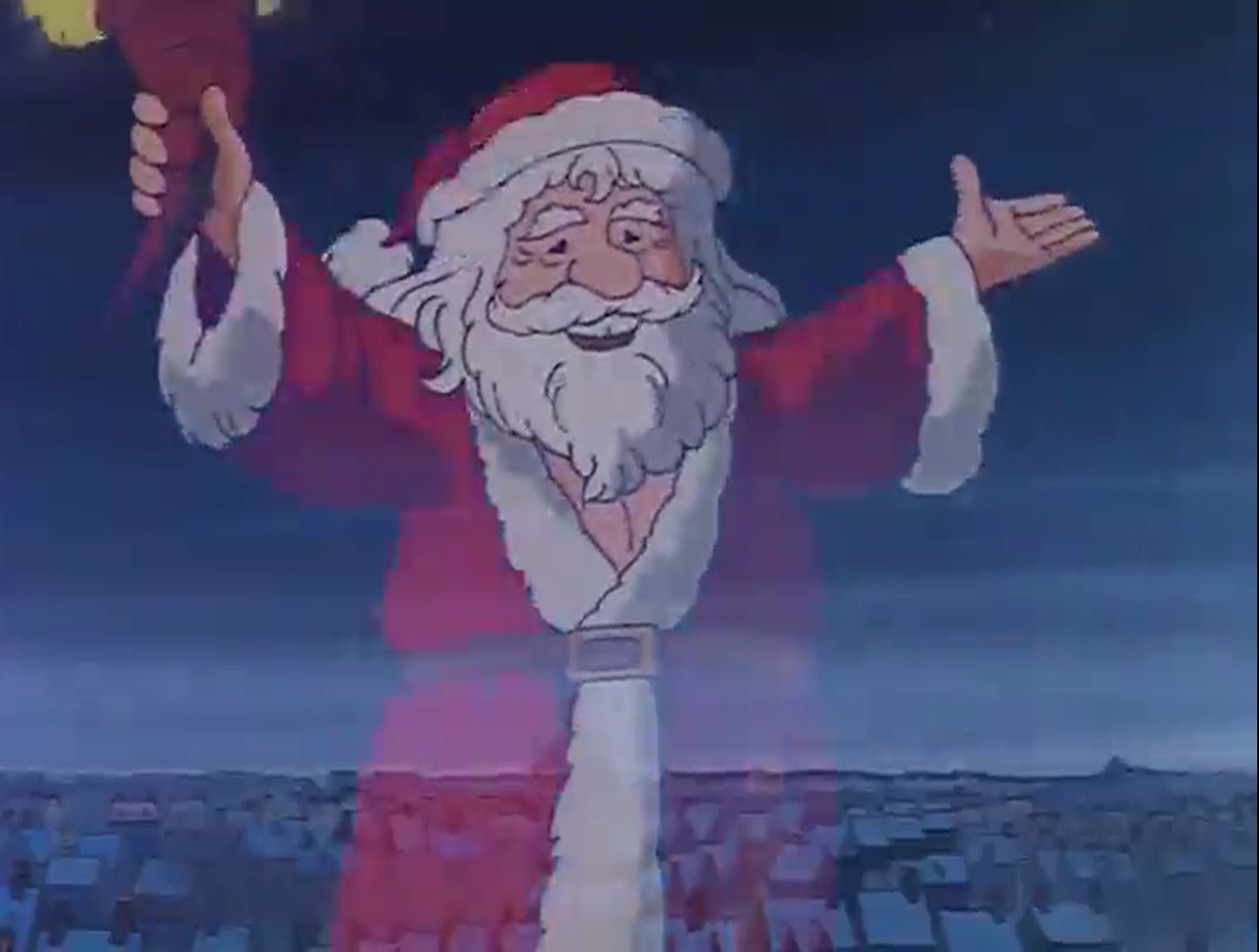
The Spirit looks even more Father Christmas-like than usual here – he already has a white hair and beard, so doesn’t age across his time with Scrooge. This is probably very deliberate, as there is a moment when Santa Claus is being sung about when we see a shot of him with his green cloak turned to red, linking them very much as one and the same figure with a tad less subtlety than usual.

 
We get the two main visits of the section – to Bob’s house, and then to Fred’s. One thing that struck me about the animation here is that the Cratchit children, or at least the boys, really do have grotesquely thin legs. It’s a wonder any of them can stand up without the things snapping beneath them.
 
There’s a very syrupy song that slows the whole thing down into a kind of second-rate version of Yes, Virginia, There is a Santa Claus, and then when we get to Fred’s there’s only a brief bit of the party before we get into a very religious mode, with stained glass-style shots of the Nativity and the same reminder of the Christianity of Christmas as in the 1956 version. Still a good point about the gold being a pointless present for a king, though.


Oddly, it’s after the visit to Fred’s that Scrooge asks whether Tiny Tim will live. This then all gets sidetracked into another rather mawkish and forgettable song.
 
Yet to Come:
Quite a brief rendition, here. There’s the tiniest glimpse of the Old Joe segment, and then the Spirit – depicted in traditional fashion – shows Scrooge his gravestone. We also get a revisit from the spirits Scrooge was shown outside of his window, and the Devil himself makes a brief cameo appearance – harking back, I suppose, to that earlier line about Scrooge being his stooge.
 
What’s To-Day:
Scrooge not only sends the boy to go and buy the turkey, he also gets him to deliver it to the Cratchits – not even having to give the boy their address. In a scene which evokes memories of the 1970 musical, Scrooge then heads off to the toyshop, although unlike in that film he has the toys sent to the Cratchits, rather than delivering them himself.


He then heads off to Fred’s party, and the next day we have the usual closing scene of him playing his little joke on Bob. We then also get various little glimpses of Scrooge handing out piles of gold coins to people with abandon – including a pair who I assume to be the two charitable gentlemen, who didn’t feature in their usual place near the start. The Ghost of Christmas Present did refer to Scrooge’s “surplus population” remark, however, so I wonder if perhaps they were originally included but then cut for time.
 
Review:
As with the original live television version of 1956, there are a few nice songs – the opening number especially, with its lines about a Christmas story written long ago. But few of them are as memorable or striking as the biggest hits of the 1970 or Muppet versions. Those in the Christmas Present section particularly transgress what’s sure a cardinal sin of musicals – slowing the whole story down rather than moving it along.


Aside from that, though, there’s little that you could say was really bad here. The animation’s of a high standard, and there are some very interesting touches like the old, sad Belle. It’s certainly miles ahead of many if not most of the other animated versions I have so far covered here on the blog. But it’s difficult to say it’s particularly great, either.
 
The 1956 version was impressive because of its nature as a live action musical done as a live television production, and managing to pull that off. No matter the skill involved – and there certainly is that – this animated version can never quite match that, really.
 
In a nutshell:
Not at all bad, but even if you want a child-friendly version there are better ones out there.
 
Links:
Wikipedia
IMDb
 

Monday, 23 December 2019

The Stingiest Man in Town - 1956, television

Title:
The Stingiest Man in Town

Format:
Live television musical

Country:
USA

Production company:
Theatrical Enterprises, for NBC

Year:
1956 (broadcast live on NBC in the US on December 23rd that year)

Length:
80 minutes

Setting:
Victorian England

Background:
Live anthology series were some of the staples of early British and American television drama, although live productions died off in the early 1960s, as did using multi-camera studios for drama at all in the US. There, bigger budgets and different market demands saw almost all scripted productions bar some sitcoms move onto film much earlier than happened in the UK and much of the rest of the world.

This isn’t a straight drama, however – like the 1954 American TV version this is a musical, but unlike that one this is indeed live. It was an episode in The Alcoa Hour (despite being longer than an hour!), a fortnightly anthology series named for the aluminium company which sponsored it, which alternated with Goodyear Television Playhouse on NBC from 1955 until 1957. This particular episode was broadcast live from New York, although I don’t know whether it was then performed live again a few hours later for the West Coast audience.

The Stingiest Man in Town seems to have been one of the highest-profile and best-remembered episodes of Alcoa Hour, with an original soundtrack album having been recorded by the cast, as advertised at the end of the broadcast. It lived long enough in the American popular consciousness to be considered worthy of an animated remake in 1978, although the 1956 version which survives today is a rather grimy film recording of the live broadcast.

And now, a word from our sponsor...
Cast and crew:
Basil Rathbone as Scrooge really does seem to have been Mr Christmas Carol in the 1950s. Two years before this he’d played Marley in the earlier American television musical, and three years later he was Scrooge again in another TV adaptation, this time a non-musical version made in Britain. There can’t be many people who’ve had three such prominent roles in three different versions of the Carol, and all within the space of five years, too.

Young Scrooge is played by Vic Damone, perhaps better known as a singer but one of the biggest names in the cast. Martyn Green as Bob was well-known as a leading man with the D’Oyly Carte company in their Gilbert & Sullivan productions, while Patrice Munsel who plays Belle was a distinguished opera singer, so they certainly didn’t hold back on getting a powerful singing cast in.

Janice Torre wrote the script and lyrics, with Fred Spielman handling the music. The pair were an established songwriting team whose best-remembered work these days is probably the song “Paper Roses”, written in 1960 but perhaps most famously a hit for Marie Osmond in 1973. Director Daniel Petrie had a hugely long and distinguished career in television, first directing for the medium in 1949, and his last work being a TV movie over half a century later, in 2001. A Canadian, he also worked in film and his 1980 film Resurrection saw two of its performers nominated for Academy Awards.


Underdone Potato:
Fans of David Croft sitcoms may like the opening line-up here – instead of a ‘You Have Been Watching’ sequence of shots of cast members at the end, we get a sort of ‘You Will Be Watching’ version, complete with voiceover of who each one of them is.

Unusually we don’t begin from Scrooge’s perspective, nor even from Bob’s as has occasionally been done in the past. Instead, in common only with the 1938 film version so far as I can recall, we begin with Fred, singing and dancing in the streets about “an old-fashioned Christmas,” which has a certain irony to it as many of the festive traditions we now regard as old-fashioned were either brand new or not yet established when the Carol was first written.

Also unusually for Fred, he has a present for his uncle when he finally finishes his song and goes in to visit him, although as you might imagine it’s not one which is particularly well-received, and we don’t really get a clear look at what it is. Scrooge sees him off, as well as the two charitable gentlemen, before Bob heads home with Scrooge being very specific on this occasion about how much earlier he wants him in on Boxing Day – two hours.

There’s an early appearance for Mrs Dilber in this version, wanting paying for doing the cleaning, and then she, a “rag-picker” character named Harry Hawkins who’s an invention of this version and a group of four beggars get the title number, “The Stingiest Man in Town”. The beggars are played by a singing group called The Four Lads, who also act as sort of Greek chorus, giving quick recaps of the story coming out of the advert breaks.

It seems odd that none of the main characters are present for the title song, which does seem to be there purely to allow time for Rathbone to get set-up in bet for the next scene, the visit of Marley’s ghost. Like Nephew Fred’s Johnny Desmond, Marley actor Robert Weede doesn’t even attempt to hide his American accent despite it being clearly a British-set version, but that’s more forgivable in a heightened-reality version such as a musical, I think.

We get a taste of Scrooge seeing some of the other helpless chained spirits, and a moment from the book which hardly any other version – perhaps no other version – does when Scrooge recognises one of them. I was interested and amused to see that as he does in the 1959 version, Rathbone sees Marley off with a little wave goodbye as he goes!

Bye bye Marley!
Past:
The Ghost of Christmas Past is an older, bearded man, going against what’s in the book and making for less of a contrast with the following visitor. He talks to Scrooge about his schooldays and his sister Fran, but we don’t see them – instead, we head straight to the Fezziwigs’ Christmas party, where as usual for most adaptations Belle has been introduced into the action early. As with Bob Cratchit being told exactly how early he has to be into work for the day after Christmas, they’re very specific about timing in this version – the spirit tells Scrooge that this party was “forty years ago.”

Neither Vic Damone as young Scrooge nor Patrice Munsel as Belle budge from their American accents either, but there is some nice live production work (saving the dip into view of a boom mic, impressively the only one I spotted in the whole thing) to transition from the party to a sort of dream sequence of their possible future together and them then drifting apart. There are some nice lines in their song together here with Scrooge saying he’s built a wall of gold to protect them, and Belle saying the wall of gold is now between them.

Said song does drag on, for a bit, however – I wondered whether perhaps this was deliberate, to give Rathbone a bit of a rest given that he’s in almost every scene.

The Ghost of Christmas Past.
Present:
The Ghost of Christmas Present is perhaps a little younger than usually depicted, but is his usual jolly self and even brings some backing dancers with him for his initial visit to Scrooge’s rooms. They play toys such as fairies and clockwork soldiers, and even manage to cajole Scrooge into a little bit of a dance with them.

Rathbone does a nice performance of being nervous and worried about being taken into the Cratchits’ house uninvited, concerned that Mrs Cratchit might hear him and the ghost talking. He also has a fun little bit of business with her when he takes a seat by the fire, and has to hurry out of it when she decides to sit down.

There’s a full bevvy of Cratchit children, with Martha unusually being the focus. She gets a song of her own, which takes the British Christmas tradition and crosses it over with the American as she sings to reassure her brother in a song which might as well be called “Yes, Timothy, There is a Santa Claus” – indeed, she has the very line, ‘Yes, there is a Santa Claus’ within it.

We then get a trip to Fred’s party, where he also gets a song, focusing on the nativity scene model set up at the side of his living room and giving a reminder of the Christian side of Christmas. There’s quite a good point made in this about gold being a rather pointless gift for Jesus when he was supposedly the supreme ruler of the universe.

Scrooge concerned about whether Mrs Cratchit will notice him.
Yet to Come:
The Spirit of Christmas Yet to Come has the traditional robes but human hands, and shows Scrooge a version of the Old Joe scene with Mrs Dilber and her friend Harry the rag-picker coming out of his office / house (the same building in this version, sensibly in a live production to save on sets and compact studio space) with their ill-gotten gains, including the clothes taken from his dead body.

We don’t see anything of the Cratchits mourning for Tim, but instead we go straight to Scrooge’s gravestone, where a group of dancers who might be spirits or perhaps demons of the underworld do a bit of interpretative dance which verges on ballet. Indeed, the bit with them carrying Scrooge around may remind you of a scene from over a quarter of a century later of the ballet dancers and Freddie Mercury in the video for Queen’s “I Want to Break Free”.

There’s something interesting here which isn’t often done – although is in more comic form in the more famous musical version from 1970 – when Scrooge has a chain of his own added by the spirits. As he begs on his knees for another chance, he see hands clasping at the spirit’s robes – but cleverly, they’re not Rathbone’s, as he’s nipped off back to bed on the set next door to be ready for the start of the final section.

What’s To-Day:
The 1951 film version was only a few years old at this point, and I wonder if the fact that Scrooge sees Mrs Dilber and joyfully greets her after he wakes was an influence on the same happening here? (Although as I’ve said before, the antecedence of that scene, like other elements of the 1951 film, seems to be in the 1935 version). She also takes the place of the boy out of the window, telling Scrooge what day it is.

Scrooge heads off to the Cratchits’ with presents for them all, and I like the way in which he interrupts part-way through the scene we have already seen in the Christmas present section. This means Tim doesn’t get his song about Santa Claus from Martha, but he confirms he does indeed believe in him after Scrooge’s visit. Luckily, the turkey Scrooge provides is already cooked, saving them the trouble of having to do it.

Scrooge declines the invitation to stay for lunch, instead heading off to Fred’s although we don’t see it. We do seem him lined up with the entire company to wave us farewell, although before we get the end credits we have a filmed advert for our sponsors, extolling the virtues of Alcoa Foil this Christmas time.


Review:
If, like me, you’re interested in the history of television and how it was made, then this is a fascinating production. American television abandoned live productions and indeed multi-camera shooting for most scripted shows aside from sitcoms far earlier than the UK and much of the rest of the world did, so this is a glimpse into a world and a type of television that before long would disappear altogether.

I suppose part of the problem is the fact that the audience would have been familiar with epic Hollywood musicals, so even the most ambitious live multi-camera studio production could ever compete with that. Nevertheless they certainly do their best, and while some of the songs do outstay their welcome a touch, they’re certainly much better than the ones in most of the other musical adaptations of the tale, barring the 1970 musical and perhaps the Muppet version.

For a live production with so much singing and dancing, there are impressively few missteps, too. There’s one boom shot I spotted, which I mentioned above, and perhaps one or two very minor line fluffs, but apart from that the cast all do extremely well. Rathbone in particular is excellent – a very good Scrooge, and it’s a shame that perhaps his performance has been forgotten over time.

In a nutshell:
If you’re not used to or don’t enjoy watching grotty, smeary film recordings of archive TV broadcasts then this may not be for you. But if you can stand that, then I think it’s an enjoyable and interesting watch.

Links: