A Christmas
Carol
Format:
Digitally-released feature film for online streaming
Country:
UK
Production
company:
Zoghogg Studios
Year:
2018
Length:
75 minutes
Setting:
Contemporary
Scotland
Background:
Another
straight-to-streaming effort of the kind we’re seeing with increasing
frequency, this was released direct to Amazon Prime’s video service in 2018,
although according to its IMDb page it has also had some television screenings
in countries such as Greece and Turkey. It’s one of the few adaptations of the
Carol
– the first that I know of for sure, anyway – to have been shot in Scotland,
where production company Zoghogg is based.
Cast and crew:
Zoghogg is run by
David Izatt, who directed
A Christmas Carol – his first feature film.
Izatt seems to have been primarily a photographer, before moving into
cinematography and then full-blown directing with this film. He wrote the
script alongside producer
Stuart Brennan, who also stars as Scrooge. Brennan
has a long list of producing, directing and acting credits on his IMDb page,
but frankly nothing you’ll have heard of.
Izatt himself
makes an appearance as a baker, and fellow Zoghogg team member and ‘face of
Scotch Beef’
Chris Capaldi is another original character, which probably gives
you some idea of the talent pool from which they were fishing. Probably the
best-known cast member is
Bonnie Wright as Nell – as a child, Wright featured
as Ginny Weasley throughout the
Harry Potter film series.
By far and away
the biggest name involved in the production, however is
Roger Taylor – yes the
drummer from Queen – who provided the music. Taylor’s wife
Sarina also appears
in the film, as this production’s version of Bob “Cratchett”.

Underdone Potato:
Scrooge in this
version is the owner of a whisky distillery, although this doesn’t actually
become clear until a little way in. What does become clear fairly
quickly is his mean streak, firing a couple of his 2500-odd employees for being
five minutes late, and pointing out to them the calculation for a month’s worth
of someone’s salary he’d lose across the year if everybody was five minutes
late.
Back in his
office, we get versions of all the standard opening segments, although with
some interesting changes made to them. The charity collectors, for example – a pair
of young women called Charity and Grace, in not the script’s only example of
not being particularly subtle – are called back in after initially being dismissed,
and given a staggering donation of a quarter of a million pounds. Bob is
amazed, until when they’ve gone again Scrooge points out that the money is the
£100 Christmas bonus all his employees were entitled to, which he can now make
tax deductible. I suppose his assumption is they’ll look churlish complaining
that he gave their bonuses to charity – specified as the British Heart Foundation
in this case.
Fred also turns
up during this sequence – indeed, we’re told it’s he who let the charity
collectors in – but rather than being Scrooge’s nephew on this occasion, their roles are reversed and he’s
his uncle. He asks Scrooge to come around for Christmas the following day, but
of course Ebenezer is not keen. For reasons which are not explained, Fred has turned up in full Scots ceremonial dress.

There’s a version
of the exchange with Bob about her not working on Christmas Day and being in
all the earlier on the 26th, before an odd scene with a woman called
Carol – again, not very subtle – who I mistakenly assumed was this version’s
interpretation of Belle, as she appeared to be a ‘lost love’. She asks Scrooge
for a lift home when he’s just got into his chauffeur-driven car, as she just happened
to be passing for some reason, but what she sees what a miserable bastard he is
decides to get the bus instead.
Someone who does
join Scrooge on the way home, however, is Marley, who appears to him on the
journey. It’s quite a harsh and brutal interpretation of the character, and as
his warnings continue once Scrooge has arrived home there is some dialogue from
the ghost saying that he was always bad but Scrooge wasn’t, which is why he can
be redeemed. No chains in this version, although they are mentioned so are presumably
meant to be more on the metaphorical side.
Past:
The Ghost of Christmas
Past is a young woman in this version, played very well by Rebecca Hanssen
despite the fact that she’s unfortunately been saddled with a costume which looks
as if the Spirit picked it up from Ann Summers.
 |
| The Ghost of Ann Summers Past... |
Fortunately this
doesn’t distract too much, especially as we rarely actually see her during the
visions – while Scrooge is present in all of them, for much of the time the
Spirit herself is only a disembodied voice. A good job too, as she’d catch her
death of cold going around various Decembers in that get-up.
We learn quite a
bit about Scrooge’s early life through this section. We see his schooldays, but
rather than a sister coming to collect him to return him home, we see him being
told of hits parents’ death in a car crash – Fred, we learn, raised him through
most of his teenage years.
There is then a surprising
relocation to the USA, which I’d assumed was done by getting hold of some stock
shots of an American city and one or two Scottish-based American actors, but
there are some credits at the end for a US production unit, so it appears at least some
shooting was actually done there. Scrooge and Marley set up their business over there, seemingly
originally with this adaptation’s version of Fezziwig as a partner, before
Scrooge persuaded Marley to base the operation in Scotland – despite Marley not
being keen to return home. Fezziwig, being an American, presumably didn’t make
the journey.
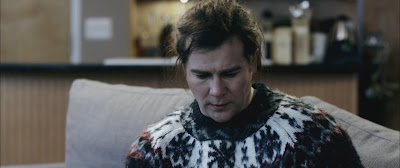 |
| Nice Christmas jumper, young Scrooge! |
There’s a link
back to the start here, with Scrooge witnessing Marley fire an employee for
being five minutes late, and explaining how much money it costs the company.
The younger Scrooge was clearly troubled by this, but doesn’t intervene on the
employee’s behalf, another indicator that Marley was always the harder of the
pair.
We also see
Scrooge’s romance with a fellow English person, a woman called Nell – not sure
why they thought that was preferable to Belle as it’s an equally old-fashioned,
and indeed Dickensian, name. There’s no happy ending for Nell in this version
after she and Scrooge part – we learn that she died a year later, although we’re
not told how.
Speaking of
death, the final vision of the past with which Scrooge is presenter is his
scattering of Marley’s ashes, soon after they’d brought the business to
Scotland. Again, there’s no explanation as to how or why he died, but given his
reluctance to come back home, Scrooge’s admission that he forced him into it
and his earlier having chastised Marley’s ghost for “leaving”, I wonder whether
there’s supposed to be an implication of suicide here?
Present:
Mark Lyminster’s
performance as The Ghost of Christmas Present is one of the weaker ones here,
not helped by being saddled with lines such as being called “The Goose of
Christmas Present” because he “likes a good stuffing” – a line straight out of
the old Alan Partridge Christmas special and Mark Eldon’s “Fanny Thomas” celebrity chef character.

The script does
redeem itself somewhat, however, with an interesting twist on the start of this
section – the Spirit asking Scrooge to pick any random passer-by on the street
for them to follow their Christmas. Scrooge picks what turns out to be an
unemployed and ill man named Reginald Thompson, who it turns out helps run a
children’s choir and is picking pennies of the street to try and help pay for a
horse for a Christmas present for one of the children in it and… Yeah, okay,
perhaps the script hasn’t redeemed itself that much.
There’s a nice
version of the Cratchit – sorry, Cratchett – scene, however, with another
interesting difference in this version in that Tim is Bob’s husband rather than
one of the children. He’s dying, in fact, of cancer, and interesting at the end
of the film there is no indication that Scrooge will be able to do anything to
help him after his redemption.
 |
| Not-so-Tiny Tim |
Instead of there
being a party at Fred’s house, we see him and some friends and family out
walking, but their discussion of Scrooge is substantially similar to that from
the book, even comparing him to an animal as happens there.
Yet to Come:
This Spirit is
never seen, but only heard – yes, it speaks in this version, although only the
odd, heavily-treated word. There does seem to be something which appears
to Scrooge, however, as he does look at it.

There’s a nice
mix of both the businessmen and Old Joe scenes into one, as Scrooge sees a group of schoolgirls
discussing his death, and as well as talking about what a disagreeable person
he was, they mention how his bedsheets were probably worth more than a car.
We also get a
scene of a rather bleak Christmas at the Cratchetts after Tim’s death, and
finally Scrooge learns who the children were discussing when he sees his
tombstone.
What’s To-Day:
In a modern
update I quite liked, Scrooge hears the news that it’s Christmas Day by
switching on the radio, rather than shouting down to a boy in the street. Although
I suppose the radio itself is quite an old-fashioned way of doing it, these
days!
Having already
given the charity collectors a quarter of a million pounds right at the start,
he doesn’t meet up with either of them again. Instead, there’s a bit of
business with two bakers at a bakery, whose entire stock of cakes and treats he
has bought-up and sent to where he knows the community will soon be gather to
present that horse to the little girl from the choir.

He goes along to
that part of town himself and knock on the Cratchetts’ door, firing her and then
re-hiring her on a much better salary. He also re-hires the two employees who
we saw him getting rid of at the start of the film. “He’s not as bad as you
said he was, mum!” one of the Cratchett children points out, which I thought
was quite a nice touch.
Finally, he meets
up with Carol again, and heads off to Fred’s for Christmas dinner with her and
the family. Carol gives him a scarf as a present, which he is very touched by,
in a scene reminiscent of Scrooge being given the same gift in
the Muppet version.
Review:
It’s funny how
similar versions sometimes come only a few days apart, quite by chance, here on
the blog. Two days ago I posted a review of
a very similar American versionfrom 2019 – a low-budget but mostly competently made and performed
direct-to-streaming version, set in the present day among a certain community,
with the lead actor playing Scrooge not being part of that community. In that
case it was the Hispanic community in Florida, whereas here despite being a
Scottish production Scrooge himself is English.
The feel of the
production – a slightly other-worldly, almost parallel-universe atmosphere to
it – also put me in mind of the
Black Mirror episode
Crocodile,
which had a similar alternative reality aesthetic with its British cast in
Icelandic locations. The dialogue here also contributes to the feeling of it
not quite being the real world as we know it. Despite being set in the present
day, Scrooge speaks in a very Victorian or cod-Victorian manner much of the time.
He also has a sword in his house, for some reason, which he uses early on to
try and warn off the coming Spirits.
 |
| "Listen, have you heard the one about the three ghosts...?" |
I didn’t dislike
that approach, however, and it does make this version feel quite distinctive.
That’s not so say it’s a perfect script – the whole Carol thing is a bit odd
and unexplained, and information sometimes comes at you in an odd order. However,
it’s shot well, the performances are almost all decent, and as you’d expect
when you have Roger Taylor on duty the music is very good, particularly some
nicely atmospheric eighties-style synth parts over bleak Scottish landscapes.
There’s also a very nice graphics sequence for the opening titles, too.
In a nutshell:
While not a
top-rank version, this isn’t bad and is a perfectly good watch if you want a
more obscure version of the story.
Links:
Amazon PrimeIMDb


